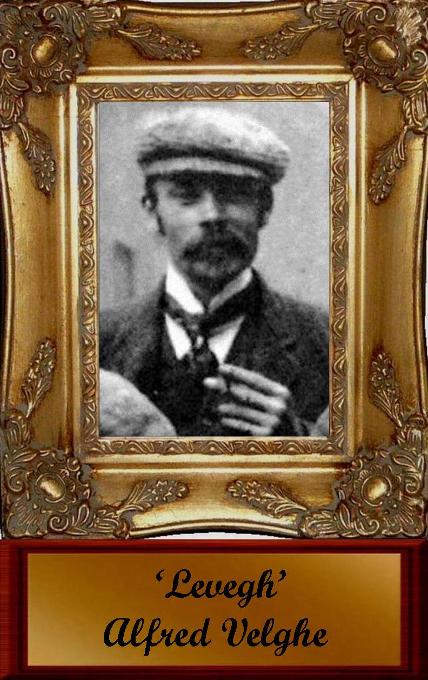
Amongst France's pioneering race car drivers in that turn of the century era was Alfred Velghe. He raced under the nom de course of "Levegh", an anagram of his real surname which he chose because it reminded him of the sound of his mother’s maiden name, Levy.
Velghe’s date of birth is not 100% clear. Most people now cite the 16th of June, 1871, in Kortrijk, West-Vlaanderen, Belgium (Courtrai, West Flanders in English), a Flemish region that crosses the French/Belgian border.
Alfred’s Levegh’s father, Albert Velghe ran a business at 48, Rue de la Chaussee-d’Antin, Paris, from June 1897. A famous tailors of motoring garments made of rubber, silk and fabrics. This firm of “tailleurs de l’automobile” (automotive tailors) was so well thought of they became ‘the’ tailors to the Automobile Club de France. Albert Velghe had come to this point due to being married to the daughter of Edward Levy who owned the tapestry house of “Aux Vieux Gobelins” at 27, Rue Laffitte, Paris. This street in the 9th arrondissment had been very well known for its free-thinking artists in the 1800s and remained so many years. When Edward Levy past away in march 1888, Alfred Velghe became the head of the well-established Goblin antique business. As such money became available for new opportunities, hence the automotive tailors’ shop.
If you are thinking Albert’s automotive clothing line was the catalyst to Alfred’s motor racing career, it would be speculation. It is more likely a natural addiction to speed. Alfred was always sport orientated and in the 1890s, while still a teenager, he began racing bicycles including events at the Stade Buffalo and Velodrome of the Seine. He even rose to be one of the stars of his era. It was this that led to his use of the ‘nom de course’ Levegh. From there, racing automobiles was a natural step for several famous drivers. Much as motorcycles had been to Tazio Nuvolari and John Surtees in the 1900s.
In 1898 Panhard et Levassor were the top brand in motorsports and had been for some time. However, Alfred joined the lesser-known marque of Mors. He was still able to establish a reputation in hill climbs and road races. In fact, he became the first man to break Panhard’s domination of automotive racing and for some time was the only man to do so.
Generally an imperturbable character, “Levegh” was also very knowledgeable about the cars he drove and he insisted on a high level of preparation and standards; all these traits probably assisted greatly in his success. The great British driver of the early 1900s was Charles Jarrott and wrote about “Levegh” in his 1906 book “Ten Years of Motors and Motor Racing”.
“Of the many brilliant drivers which France has produced, none ever shone more brightly than Levegh. To style him by his right name I should properly call him Velghe, but Levegh was the name he raced under. The name of Levegh and Mors were indicative of a formidable combination in any race, and the splendid performances achieved by him, particularly in the Paris-Toulouse-Paris race, stamped him as a Speed King. The first time I met him was in a paper-chase in which I took part in France in 1898. Driving a Mors car, he was endeavouring to make up speed at the finish in the Forest of St. Germain. He had a lady passenger with him, and as he whizzed by we were amazed to see Levegh and his passenger sitting on the floor in order to save windage, and thus increase their speed to some fractional extent, and Levegh was steering the car holding on to the steering-bar above his head. What he did when he wished to stop, I do not know—presumably he resumed his proper seat first.
Some time after this I met him again, and he had a great story to tell me of a marvellous racing-car which he was having built. As far as I could understand it, the special idea was in the body of the car. It was to have a top like an inverted boat very strongly built and with just a hole in it for the driver to see out of. If, owing to the terrific speed —a motor of at least 12 h.p. was going to be used— the car turned over at a corner, the driver merely tucked in his head, the car rolled over and over, and the driver, being safely inside, escaped unhurt. Duncan, who was with me at the time that this extraordinary idea was propounded, was thrilled, and told me afterwards that Levegh with such a car would beat everybody. The whole idea must have been visionary, as I never saw the car and I am afraid that Levegh's dream was never realized. Bordeaux-Biarritz in 1899 was his first success, but he with his Mors car pressed De Knyff severely at one stage of the Tour de France race of the same year. His great success, however, was in the Paris-Toulouse-Paris race in 1900, when, after a magnificent duel with the Panhard cars, he lowered their colours, and won the race, covering the 1348 kilometres in just over twenty hours.
As I have before mentioned, he was brilliant as a driver, but at the same time he had not the excitable character which is usually associated with the French nationality. Levegh was cool to the degree of coldness. He never appeared to hurry over anything, and never allowed anything to perturb him; and yet when driving he was a veritable whirlwind. His knowledge of his car was perfect, and much of his success was due to the high state of perfection in which he kept it. He is of the little band who have laid down their lives for the sport. Inherent consumptive tendency was aggravated by the exposure and hardship involved in motor-car racing, and at the height of his fame he retired from the sport and journeyed to a strange land to die.
Practically his last great race was when he defended France in the Gordon-Bennett race of 1901.”
Racing history
1898. In his first year of automobile racing “Levegh” showed more than a glimpse of his driving ability. He won some Hillclimbs in France and the ‘big’ race of 1898 the City-to-City race of St. Germain-Vernon-St. Germain. Held on the 20th of October 1898 Alfred Velghe drove his Mors to 1st place.
1899. More wins would come in the following year as he learned his trade against the biggest names of the day, and might of the Panhard team. A busy (for the time) calendar saw Levegh finish 10th, ahead of his team mate Roscoff, in the 120.7km race of Nice-Castellane-Nice held on the 21st of March, 1899. This race included 15 tricycles which being lighter were often able to keep pace with the larger engined cars. Panhard took a 1-2 with Georges Lemaître & Leonce Girardot.
In May Levegh took part in the 565km Paris-Bordeaux trial along with Mors other drivers Antony, Broc and Fourgerat. It was a Panhard whitewash with the first 5 places being filled by P&L cars. Antony was the leading Mors driver in 6th, Broc was 10th and Levegh 14th Fourgerat came last of the classified finishers.
Panhard were equally dominant 2172.5km Tour de France Trial held over the 16th-24th of July, 1899. Levegh did lead home the Mors team in 8th place beating team mate Camille Jenatzy which is quite a feat in itself.
Mors would take their revenge and break the Panhard stranglehold on racing in the 371.75km Paris-Saint Malo race on the 30th of July, 1899. The race had 3 classes, 13 cars, 12 voiturettes, 64 tricycles; a field of 89 competitors. Antony, in car #10 won for Mors followed home in 2nd place by Levegh. The third Mors of Camille Jenatzy finished 7th.
On the 1st of September, 1899, the 323.5km Paris–Oostende race was declared a “dead heat” by the officials. Both Levegh, Mors car #7, and Léonce Girardot, Panhard, finishing in a time of 6h11m; giving an average winning speed of 52.32kph.
At the next race on the 17th of September Levegh Mors finished 2nd, less than two minutes behind Leonce Girardot Panhard in the 231.5km race from Paris to Boulogne. Broc was 3rd a further 10 minutes back. 4th was a young British driver by the name of Charles Rolls driving his own Panhard.
Mors won again on the 1st of October, 1899, when Levegh won the 262.5km race from Bordeaux-Biarritz event on his Mors 16hp. This time Antony, real name Mr. Debraye, was 2nd for a Mors 1-2.
Clearly a good year for the Mors team with three outright wins, and a fourth win shared with Panhard, and several podium positions achieved too. Levegh must have been looking forward to the 1900 season.
1900. This was to the season which would elevate Levegh to “Diver of the year” status. Racking up wins in hillclimbs, La Turbie (Nice), and the Estérel Climb near Cannes, and on the road Levegh became real threat to all the established stars.
In the June of 1900, over the 3rd &4th to be correct, a race from Bordeaux to Périgueux and back covering 318km was won by "Levegh". Driving his 7.3-litre Mors 28hp Mors at a remarkable average speed of 77.9kph Levegh cover the distance in just 4h4m25sec’s. Giraud was second for Panhard over 8m adrift. American debutant Bostwick brought his 16hp Panhard & Levassor third. Another 8m behind Giraud.
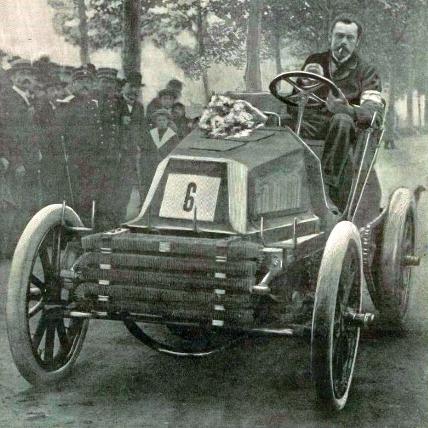
The 1900 Gordon Bennett Cup, or International Trophy, race was held on the 14th of June. Panhard cars had been selected for the three-car French team so there was no place for Levegh as a scoring participant. He was allowed to take part though. Charron would win the 568.66km race from Paris to Lyon for Panhard and France of course, but the second car home in the event was the Mors of Levegh. Because he wasn’t an ‘official’ contestant, 2nd place fell to the Panhard of Girardot.
This event was not considered a success by James Gordon Bennett Jr. himself and had minimal input from other racing countries. In time it would become a very important precursor to the Grand Prix motor racing which grew from 1906. None of which takes anything away from Levegh’s achievement.
A unique accolade which falls for Alfred Velghe, AKA "Levegh" is that of winning the heavy car, often called the "race car", class of the only Olympic motor car race ever held. Contested during the 1900 Paris Olympic Games over the 25th to 28th of July, 1900, many classes of automobile and motorcycle took part in 16 events with different classes. The main event was the Paris–Toulouse–Paris race which would run over 1348km of open-road. Divided into three stages, Montgeron-Toulouse, Toulouse-Limoges and Limoges-Montgeron, with 82 control points along the route. Each crew competed against the clock rather than directly against each other. Of the 78 participants 21 made it to the finish line.
At the end of the race 'Levegh' had an elapsed time of 20h50m9secs for an average speed of 68.18kph, 40.2mph. The Panhards of Pinson and Voight finished ahead of ‘Levegh’ on the road, giving them 2nd and 3rd places, but they couldn’t better the time of Levegh’s 7.35liter, 28hp Mors Z, racing #6.
If you’re surprised by the inclusion of motor sports in the Olympic Games you perhaps shouldn’t be. After all, this was only the second edition of the modern Olympic Games and the automobile was the new mode of transport. Four years later at the 1904 St. Louis USA games motorcycling events were again held as unofficial "demonstration" events which didn’t count toward the medal tally. For comparison, other demonstration events at the Paris Olympics included fire-fighting, kite-flying and pigeon racing, none of which have ever been seen in another Olympics.
On the 1st of September 1900 Levegh won another event this time organised by the Automobile Club d'Ostend at a meeting at the Hippodrome Wellington, d’Ostende Belgium.
Levegh would go on to win the 197mile Bordeaux-Pengueux-Bordeaux race at an average speed of 48.4mph. And, the 1900 Paris-Berlin race; providing the final proof of his ability, and Emile Mors' policy of 'build bigger ... build faster' for the 7.3-litre racing Mors vanquished Panhard at both events.
1901. Levegh’s last major race was the 327.5mile Paris-Bordeaux race on the 29th of May, 1901. The race also held the 2nd Gordon Bennett Race (also known as Coupe Internationale) concurrently. The route started in Paris then went to Versailles, Chatres (79km), then Chateaudun (124km), Vendome (163km), Tours (220km), Poitiers (321km), Ruffee (388km), Angouleme and on the Bordeaux. There were sixty entrants for the combine events but in truth the Gordon Bennett ‘International trophy race only had three entries, all French. The three French entries being Levegh with a 28hp Mors ‘Z’, although the drivers thought 60hp would have been a truer power figure, Fernand Charron and Léonce Girardot both driving Panhard cars. The sole British entrant, the #3 Napier 50hp driven by Selwyn Francis Edge, had used up all its British tyres and was forced to fit French tyres. This made it instantly ineligible for the Gordon Bennett race and it didn’t start either race.
This race was started at 04:00hrs in the morning. The sleep deprived Fernand Charron’s Mors, #1 was the first car to leave but almost immediately stopped to have some maintenance adjustments made. "Levegh" (Alfred Velghe), Mors ‘Z’ car #5, was next the second car to start and was ahead of Charron by the time they reached Versailles. The remaining Gordon Bennett contender Léonce Girardot was third off the start line.
Charron would retire his Panhard at Vendome due to continuing valve problems. Levegh continued through Tours but at Sainte-Maure his car hit a ‘gutter’ so violently his Mors was also forced out of the race. This left Léonce Girardot to take the Gordon Bennett trophy at an average speed of 37mph. Interestingly, he was just 9th in the overall Paris to Bordeaux event. The overall race being won by Charron’s former riding mechanic, and Mors’ new star, Henri Fournier driving Mors car #18. He was 2hs40mins ahead of Fournier, with an average speed of 53mph. Had he been the the Mors representative in the Gordon Bennett trophy the Mors would have had the Glory rather than Panhard!
Alfred Velghe retired from racing at the height of his fame, had he continued and made a more of mark in the Gordon Bennett and early Gran Prix era perhaps he would be better remembered. However, he was suffering from lasting ill health which most likely contributed, if not forced the decision.
He started to develop chest problems in 1901 and at the end of 1904 Alfred Velghe caught a cold which was too much for his weakened body to fight off. He passed away on the 28th/29th of February, 1904, at his winter home of villa Bagatelle in Pau, Aquitane, the Pyrénées-Atlantiques department of south-west France. The popular Mors driver was just 33 years of age. It would seem "Levegh" had be battling tuberculosis, which is the indication made by early newspaper reports of the time.
His funeral was undertaken at “La Trinite" and he was put to rest in the family plot at Père Lachaise Cemetery, Paris. His obituary perhaps best tells us all we need to know.
“… in 1899 had begun driving Mors cars in all the great races. He had won the Paris-Ostend and Bordeaux-Biarritz races … in 1900 he had been elevated incontestably to racing Champion status by victories in the Paris-Toulouse, Bordeaux-Perigueux and in the sprints of the Speed Week at Nice.”
“Alfred Velghe, better known under his pseudonym 'Levegh', was a sportsman in every meaning of the term. He possessed to a great degree the qualities of sang-froid [composure or coolness shown in danger or under trying circumstance] and prudence and was known as one of the most reliable of drivers.”
Pierre ‘Levegh’
Approximately 17 months after Alfred Velghe died, his sister gave birth to a boy whom she named Pierre Eugène Alfred Bouillin. Pierre Bouillin proved to be a very able sports man, a world-class ice hockey and tennis player. Like his uncle, Pierre turned to motorsports in his twenties and when he did, he chose to honour his uncle by reviving his ‘nom de course’.
"Pierre Levegh" proved himself to be a very able driver, so much so that Alfred Neubauer recruited him to drive a Mercedes works 300SLR in the 1955 le Mans 24hrs. It proved to be a tragic decision for all concerned. “Levegh” died on the 11th of June, 1955, at a relatively young age; just like his uncle.
Alfred Velghe fought against, and beat, many of the great masters of the City-to-City and Gordon Bennett Trophy racing era. People like Camille Jenatzy AKA “the red devil”, René de Knyff, Fernand Gabriel, Léonce Girardot, Henri Fournier, Marcel Renault, Count Eliot Zborowski and Charles Jarrot.
He drove predominantly for Mors, a word that in Latin means death (along with mortem, obitus, decessus). So noticed at the time by an anti-motoring politician, who went so far as to say that the brand name “implied that Mors drivers had the licence to kill anyone who crossed the path of their cars”. If anything was killed by the Mors brand name it is, perhaps, Alfred Velghe’s legacy to motorsport.
When the great races of the time were not measured in hours but in days, over unmade roads and with little outside support, “Levegh” was one of the top aces. His image being on postcards of the era promoting the top ten drivers of the day.
Today the name "Levegh" is remembered in connection with the terrible events of le Mans 1955 but this most unfair to the memory of a man, who in his time, was considered “one of the immortals of the period”, clearly highly regarded by his racing contemporaries.