1948-60 Citroen 2CV Series-A
Very few cars, if any, engender a sense of freedom and fun like the 2CV does. Devotees love them, collect and restore them to this day.
For post WW2 France, struggling to recover from the many ravages, the little car Pierre-Jules Boulanger brought forward to mechanise French farming was just what Citroen, the French economy and the French populace needed. It proved so perfect for the time that with relatively few changes the Citroën 2CV would remain competitive for over four decades.
Citroen had everything in place to launch the 2CV in late 1939. But then the war scuppered everything for the firm and officially all Citroën TPV/2CV development stopped. We now know that wasn’t the case; and as well as scuppering German plans Boulanger also followed up on the work of André Lefebvre, Flaminio Bertoni, Walter Becchia et al. particularly once France was liberated at the end of 1944.
André Lefebvre and Flaminio Bertoni continuously improved the designs in secret through World War Two. Their belief in the project never wavered, so much so that the new 2CV was being tested by 1946. The series-1 2CV design would come to market in 1948. The Citroën 2VC would prove to be the most functional and long-lasting design of all the ‘new’ European cars launched in the immediate post war period.
However, France elected a socialist government in late 1944 which resulted in government restrictions and the nationalization of Renault. Former naval officer and Automotive executive Paul-Marie Pons, was appointed head of French automotive policy in the Ministry of Industrial Production and the so called “Pons Plan” came into effect. The plan outlined Renault as the only French car manufacturer allowed to build cars for the low-end price bracket. Citroen’s 2CV was effectively banned in favour of the Renault 4CV.
While Citroen focused on selling the Traction Avant, Boulanger’s design team carried on refining the 2CV so that when the Pons Plan was due to be superseded in 1949 Citroen would have their new car ready to go on sale. But the delays to the 2CV going on sale led the French press to give the Citroën TPV initials new meaning. "Toujours Pas Vue" (Still Not Seen).
This delay might actually have helped Citroen in a way. At the end of the war most of France’s roads were in terrible condition and of the two million cars that had ridden on those roads had been reduced around one-hundred-thousand. And, most of them had been converted to run on gas, either from the town’s gas supply stored in bags on the vehicles roof or created by wood/charcoal gasifiers towed behind the vehicle on trailers. By the time the 2CV would go on sale the French public would be ripe for a new, cheap, economical car that would ride those awful roads comfortably. "Les années grises" or "the grey years" as that period in France was called, would soon be a golden opportunity for Citroen.
The Post-war 2CV had evolved a fair amount by the time it could be put on sale in 1949. Still a primitive machine on a very similar ladder chassis to the TPV but largely made of tubing to which the steel body bolted. Wing also bolted on and the bonnet and doors had simple easily-detachable pins through the hinges. This simplicity of construction not only helped keep repair costs down but also allowed for the huge variety of body styles that would later run on the 2CV chassis.
The most inventive part remained the self-levelling suspension, that as well as being independent for all four wheels it gave incredible ride comfort due to interconnected fore and aft in longitudinal mounted coil springs & damper units. Suspension travel was very long incredibly soft. This not only allowed the car to traverse the ploughed field as promised but also surprisingly lively cornering. Even with the narrow radial tyres the 2CV is almost impossible to roll, although you can induce frightening amounts of understeer. Good job it’s front wheel drive. Braking is hydraulic all round by drums, inboard at the front.
The front mounted engine of the 1948 2CV was a 375cc, air cooled, horizontally opposed two-cylinder design. The cooling fan and dynamo ran of the crankshaft obviating the need for drivebelts. Walter Becchia’s new engine design was mated to his new four-speed gearbox; the fourth being an overdrive that assisted greatly with fuel economy.
The extra gear was also useful in helping move the car now that it was heavier made by the use of steel panels. During the final months of the war it had already become clear aluminium was not going to be cheaper than steel, hence the change in design specs. Flaminio Bertoni restyled the car so the only part that remained in the ripple pattern now was the bonnet, one of the largest panels on the car. Front doors remained as coach-style (suicide) doors but interestingly while the front now did have two headlamps the rear only had one brake light.
On the inside the passenger cabin remained very similar to the TPV but for the new seats which looked rather like tubular framed deckchairs. The only instrumentation for the driver was the speedometer on the ‘A’ pillar and the ammeter on a small dash panel. If you wanted to know how much fuel you had, then you stopped, got out and checked the dipstick in the fuel tank. At least the windscreen wiper was now mechanised, running off the speedometer cable, fine when you’re in motion but when you stopped, so did the wiper.
By this time the small engine put out 9hp so you might wonder why it is named the two horse power. The truth is in the taxation laws of the time. This size engine fell into the “deux chevaux-vapeur”, two steam horse power taxation class bracket. Thus giving the simple name of ‘deux chevaux’ (‘two horses’). Performance of the 9hp 2CV was hardly sparkling, but still almost unbelievable. To get from 0-40kph (0-25mph) took 42.4 seconds, comedians of the time joked it went 0-60kph in one, erm, day. Top speed was barely legal on German Autobahns of the day being a sedate 40mph.
When the Pons plan met its end in 1949 Citroën had already delivered their freshly prepared 2CV design into the limelight. Officially now called the 2CV, reflecting the taxable power rating, the car appeared at the 1948 Paris Motor, the “Paris Mondial de l'Automobile”; ten years after the initial pre-war TPV was due for unveiling.
On the 7th of October, 1948, the little grey car made it's debut. Only available in grey; but it was still a sensation. Laughed at by journalists (only one Swiss magazine predicted a great future for the tiny Citroën), very quickly, a five-year waiting list developed; by 1950 it was a six year wait!
What the press called an "aberration roulante" (rolling aberration), the public saw as a charming, if "Spartan", little economy family car. History agrees with the people! It was a new revolution in the world of consumer transportation, reprising that of the Ford model 'T' in America. The long waiting list soon led to used cars selling for more than the price of a new 2CV!
The 2CV type A that went on sale in 1949 was a little different to that which was presented in 1948. That car had a pull cord starter similar to that which was so popular on lawn mowers. In 1949 the “only concession to luxury”, saw an electric starter motor replaced the pull cord.
The first 2CV type 'A' delivered was considered by some as an act of "remorseless rationality". The notoriously underpowered 375cc engine produced an actual 9hp, (6.5kW). The motor was a simple flat-twin, air-cooled, four-stroke unit which could push the little car to a meagre top speed of 65kph (40mph).
Despite all the simplicity of the 2CV the design actually contains plenty of interesting engineering ideas. To start with, the period regular ladder chassis frame is built along aeronautical lines using pressed steel framers, flat plates riveted to it and outriggers for the floor support. Additionally, two tubular cross-members, riding above the ladder frame, around which the highly innovative suspension is mounted. On the top of the chassis a thin steel body is bolted on. Because the bodywork is so easy to detached from the chassis the 2CV was ripe for conversions and, in time, a wide variety of functional vehicles would emerge from this simple platform.
The suspension is a design tour-de-force in itself. Linked fore and aft it is self-levelling and cleverly, sort of, lengthens the wheelbase on one side during cornering. As much as you thrash it and squash it, this ridiculously soft suspension always self-levels. All of which makes a 2CV almost impossible to roll; despite the very narrow looking tyres. Which brings us to another innovative feature, the revolutionary new Michelin radial tyres. Michelin and Citroën basically collaborated in their design phases so both new systems would work incredibly well with each other. The 2CV did much to help Michelin commercialise the radial tyre.
The original type 'A' body was a convertible concept within a fixed head space. A full width canvas roof could be rolled back from the top of the windscreen all the way to the rear bumper if required. Great for sunshine, wind in the hair driving, and, carrying out sized loads.
Seating was another simple yet very effective design. Two bench style frames with simple strapping supports for equally simple cushioning. Simple, lightweight seats that supported the driver and passengers in relative comfort for the era.
The simplicity theme extended to instrumentation. The speedometer was mounted on the windscreen pillar, with the single windscreen wiper powered by the same speedo' drive cable. So your driving speed dictated the speed of the windscreen wiper too! An ammeter completed the extensive pair of driving instruments. If you wanted to know how much fuel you had in the tank, you pulled over and checked the liquid level with a measuring rod. The car had one rear light unit, as require by French law, with included the single brake light. Really stood out against the grey paint. These early years cars sport an oval grill ornament with the two Citroën chevrons held within.
In 1949 only four cars a day emerged from the works, 876 in total that year. The waiting times grew longer and longer. Meanwhile, Pierre Boulanger asked 2CV owners to tell the firm what they thought of their car in a special document. All part of his plan for continuous product improvement.
Every effort was made to speed up production in 1950, building 6,196 units that year. However, is still wasn't enough to meet demand. The simple rural utility vehicle for the people was growing to be a reliable means of transport for priests, local doctors and workers from a variety of trades.
Sadly, Pierre-Jules Boulanger never saw just how successful the 2CV would be. He died when his Citroën Traction- Avant crashed on the road from Clermont-Ferrand (Michelin's home base), to Paris at Broût-Vernet, on Sunday 12th of November, 1950. His process of continual development was carried on regardless.
In 1951 the 2CV's improvements included a key operated ignition lock, and lockable doors for security. A new body style arrived in the form of the Citroën 2CV Fourgonnette 'AU' van, capable of carrying 250kg. This too would prove to be a popular vehicle in the delivery businesses, artisans and tradesmen, and so much so that a "Weekend" version of the Fourgonnette was also produced. The rear seats and side windows could be removed to carry work loads in the week, then replaces for family use at the weekend.
Originally the new Fourgonnette van was supposed to have a new 425cc engine, but that idea was quashed by management who feared people might swap that engine into the 2CV saloons. Instead the designers improved the pulling power by changing the final drive ratio's to 7x31 instead of 8x31. It also ran on larger Michelin Pilote tyres of 135x400 size instead of 125x400.
By late 1951 the international press were giving grudging respect to the 2CV. Auto, Motor und Sport magazine from Germany described the 2CV using words like "hochinteressantes", meaning highly interesting, but "Häßlichkeit und Primitivität", primitive and ugly. Waiting lists had ballooned to several years long, it is said that eventually people started ordering their next 2CV on the day they picked up their new 2CV. Just to be sure it would be ready when they were! End of year production numbers totalled 16,288.
A special preferential priority list was created by Citroën to ensure those citizens such as doctors and veterinarians, farmers, priests, midwives, tradesmen, those who needed a car for their work, had their orders fulfilled ahead of the ordinary members of the public. Total production in 1952 was more than 21,000, but France's need for foreign currency saw the export markets preceding all others on the list.
At this time the small car market was important in most European countries post was and the little 2CV was competing against German and Italian made BMW-Isetta bubble cars, as well as the Messerschmitt KR175. The VW Volkswagen Beetle was also gaining traction in the market, although the Citroën Deux Chevaux had the advantage of costing about half as much. In Britain the Morris Minor on sale and that might have been the bigger threat, the bubble cars not having the same space for people or cargo.


1953 saw “Autocar” magazine carry out a technical review, after which their report stated the 2CV was "the extraordinary ingenuity of this design, which is undoubtedly the most original since the Model T Ford". In the UK sales of the 2CV were poor. Import duties on the cars and replacement components. Other laws also worked against the 2CV, so Citroën circumvented the problems by creating a production facility in Slough, England. This also gave them a leg up in selling overseas in the British Empire and Commonwealth. The requirements for better air cleaners in the UK also helped Citroën 2CVs cope with dust better, combined with the flat bottom, all-round durability and superb suspension the 2cv could handle everything from the African Sahara to the Australia out back. Anywhere ruggedness was prized over style, good looks and comforts, the 2CV would sell.
It took until 1954 for the speedometer to get a light to aid its use at night. As for visual changes, the front grill ornament lost the oval surround leaving only the twin chevrons of the Citroën gears logo. However the starter handle crank hole always remained. New models included the 2CV PO model had additional dust protection for use in the French North African colonies. The 2CV AL Luxe or, luxury, version was produced in Belgium in the Forest (Vorst) factory. It had better bumpers, hard "alloy" wheels and decorative chrome strips. All in all 1954 was the best production year so far, 43,250 type A 2CVs were produced and sold.
A bigger 12hp, 425cc, version of the flat-twin engine led to the 1955 2CV AZ model being released. Top speed was now raised to 49mph, 80kph. Other changes were new side repeaters high up behind the rear doors. Bumpers were colour coded to the body while more interior got some cloth colour options also arrived.
New for 1956 was the 2CV AZL upgraded luxury package consisting of a windscreen demister system, a stronger starter motor and new chrome strip package. The continuous development initiative program created more changes for 1957. from simple things, like changing the colour of the steering wheel from black to grey, to an all new heating and ventilation system. From a bigger rear window, to the “porte de malle” metal boot lid. The new AZLP also got bigger rear view mirrors and new aluminium strips below the doors, but the biggest visual difference was the boot lid. Not in itself but that the full-width canvas sunroof now only rolled down to the boot lid top roughly at the bottom of the main side windows. The same level as the new third side window in the rear panel on the Belgian plants AZL3.
In March 1958, Citroën introduced a 4x4 model, 2CV "Sahara". This was a very special design with two engines which could run in three modes; AWD, 4x2 or 2x4 Clearly for the North African, or similar, markets. Externally it was a 2CV but with a spare wheel on the bonnet. It wasn't the big seller the company hoped it might be and production stopped less than ten years later, few units were sold.
As the 1950s was coming to a close the world was changing quickly. Customers were wanting more in their cars, even the little 2CV now needed some of those luxuries that were becoming popular in other cars. A new front windscreen demister was supplemented by an interior heating system. A detachable radio that could be used in the car or taken into the house. Exterior and interior colour options increased again too.
At the end of the type A series run the 2CVs all got wider, 135×380, tyres and stronger wheels. After 1960, the type B would go on sale. Still a utilitarian vehicle, still spartan; but with new styling for the 1960s.

The ‘tin snail’, "an umbrella on wheels", comedians and the motoring press just loved to poke fun at the 2CV. In America they asked "Does it come with a can opener?" In Britain Autocar magazine said “it is the work of a designer who has kissed the lash of austerity with almost masochistic fervour.” The ridiculed went on. How fast is the Citroen 2CV? It’s not! zero to 60mph in ‘about a day’.
A good laugh is fine, but does rather mislead the audience. The 2CV was never meant to be fast, or luxurious. L. J. K. Setright saw the 2CV as "the most intelligent application of minimalism ever to succeed as a car". The Globe and Mail wrote of the 2CV it is a "car like no other". And that was the point. Flaminio Bertoni always said cars should “set trends, not follow them”, and his work on the 2CV project personified that belief.
The 2CV was tour de force of rationality, practicality and affordability. With the aim of “maximum mobility at minimal cost” when France was still clawing it's way out of the rubble of WW2. This go any-where, do anything little car supported the small rural businesses to prosperity, helped livelihoods to grow and maintained the links between families and communities over war-torn roads in the days before the “autoroutes.”
Built to a simple formula of low cost, reliability and ease of maintenance, the design is one of the most noteworthy automotive designs of all time. A combination of innovative engineering, simplicity and utilitarian practicality. A symbol of French style and resilience in an period of austerity. A down to earth motoring experience for a populace used to a simple life of hard work.
2CVs were everything to everybody, as happy taking the children to school as they were traversing a ploughed field, or taking the family out into the countryside for a picnic the day after hauling a load to market. The simple little car improved peoples lives. Championing the cause of the would-be motorists, offering joy in pure simplicity, allowing the populace to embrace the freedom and adventure that comes with a motoring lifestyle.
The classic French family car, a symbol of national identity. Arguably amongst the archetypes of global car culture the 1949 2CV was unlike any car that preceded it. Causing a stir in the automotive world as big as that which the Mini would a decade later. It has without doubt one of the worlds most significant vehicles and had a huge impact on the lives of the ordinary French public. More than that, the 2CV was a commercial success. By the end of production in the 1990s millions had been built.
Full of Gallic panache there is a certain allure to a 2CV. So much so there are thousands still running to day. Collectors search, find and restore rusty hulks to the former glory spend far more money than the original car ever cost. The 2CV fan base is large, globally large; with meetings being on the international, inter-continental level. Proof, if it was needed, that the little French icon holds a romantic place in automotive hearts, everywhere.
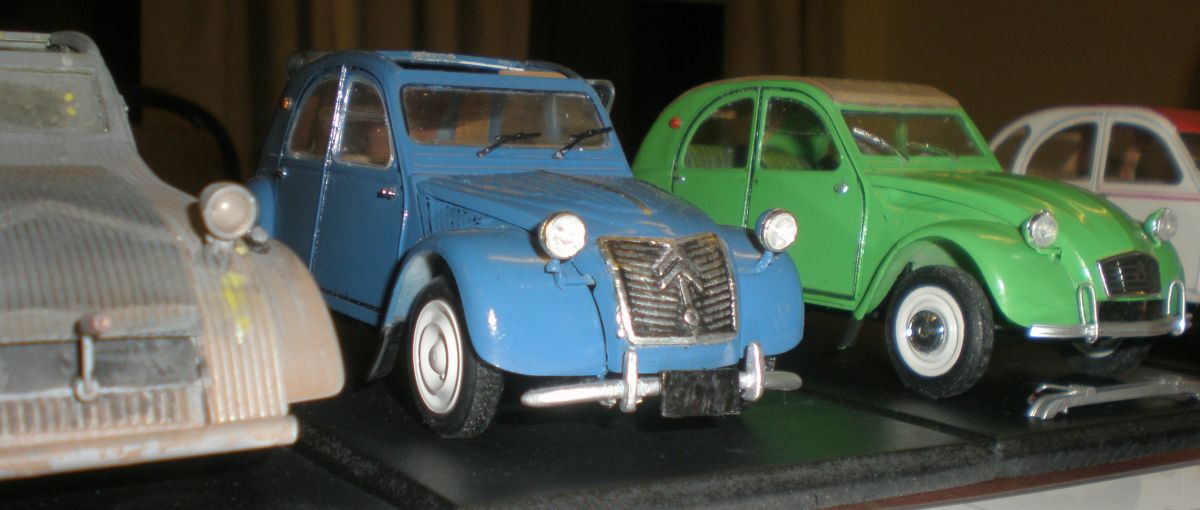
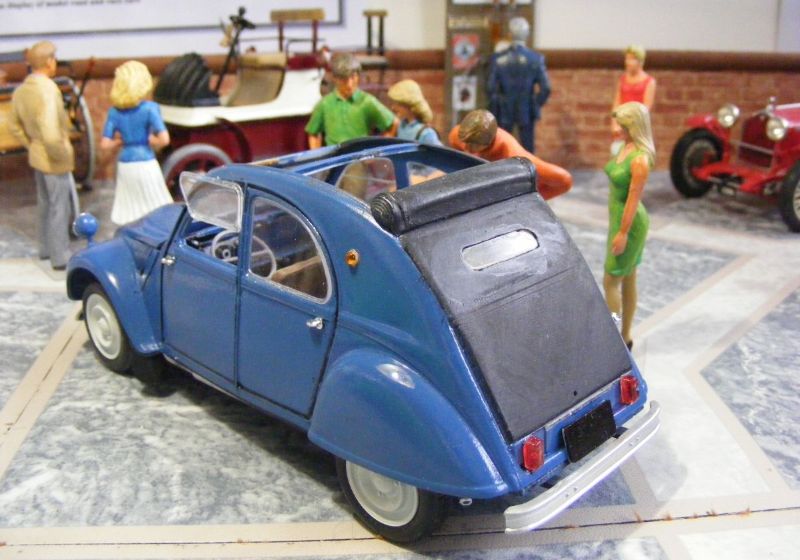
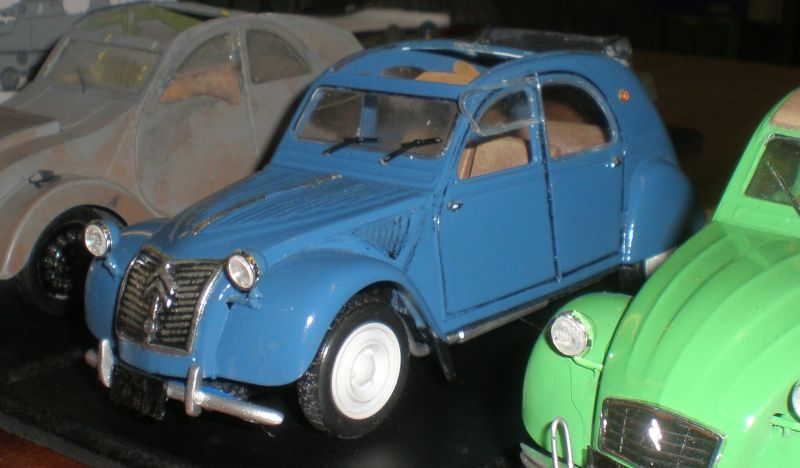
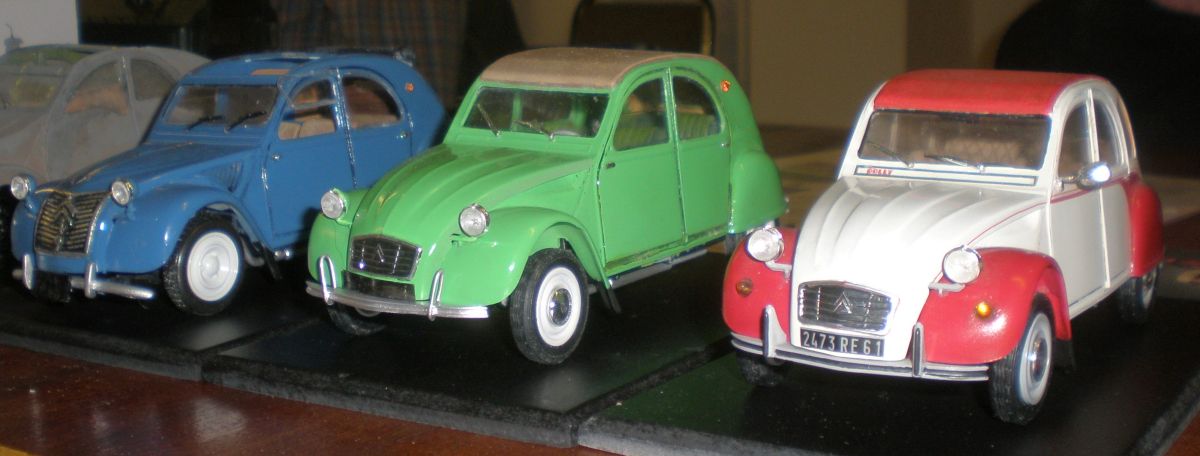
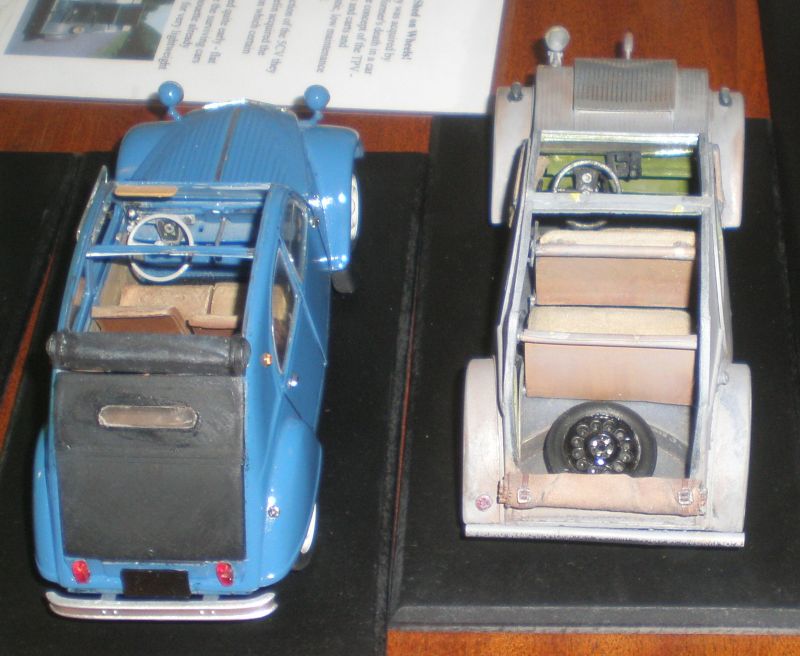
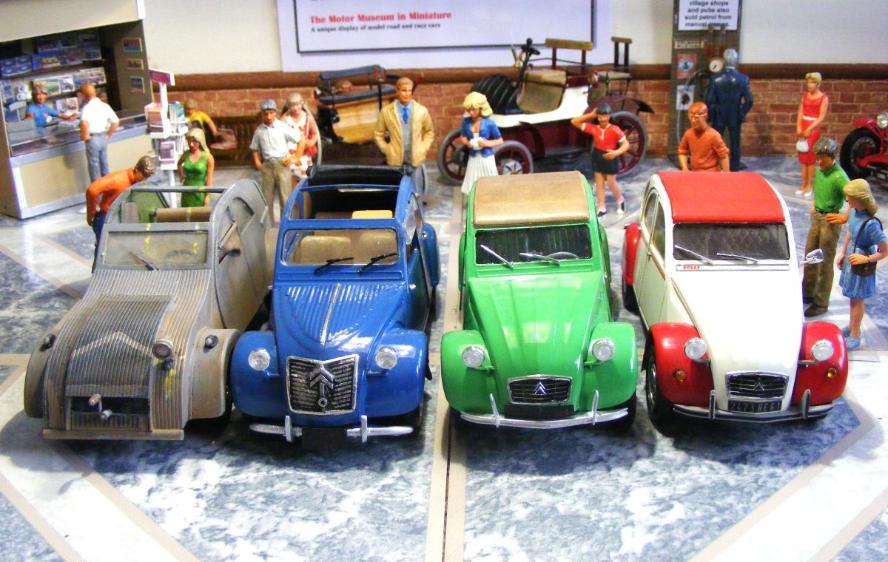
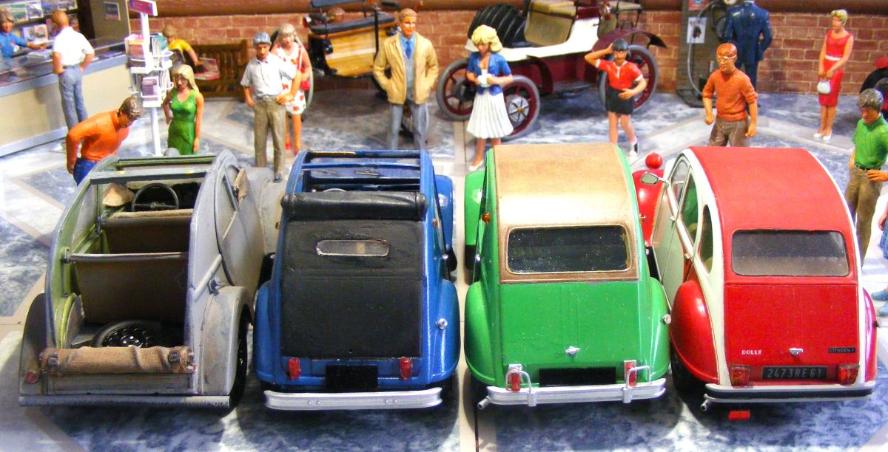

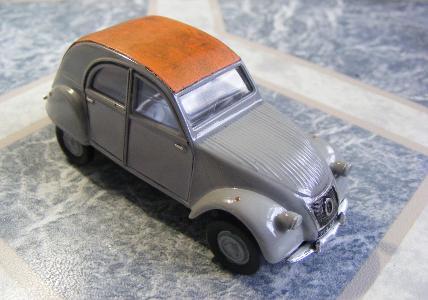
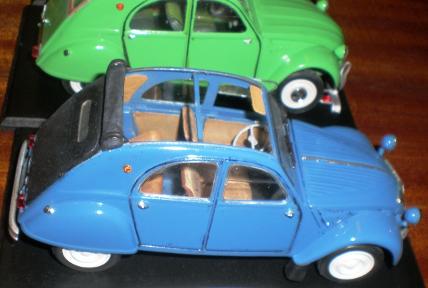
This Heller 1/43rd scale kit, # 80175, was first released in 1979. Being part of a growing range of European cars of the 1970s and 1980s. There were a few, largely French, cars from earlier times that were included in the range. The kit has been re-released a further 14 times since the initial 1979 launch (including one release in 1982 during the Heller/Humbrol combination and one very rare release by “Modelist”, as kit # 604318, in the 2020s), each time having a new box; though the kit has remained the same.
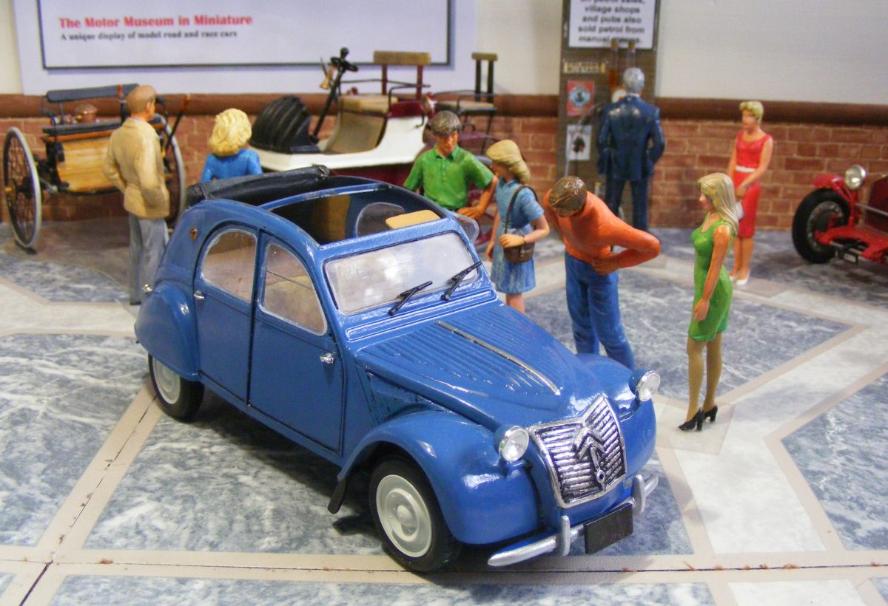
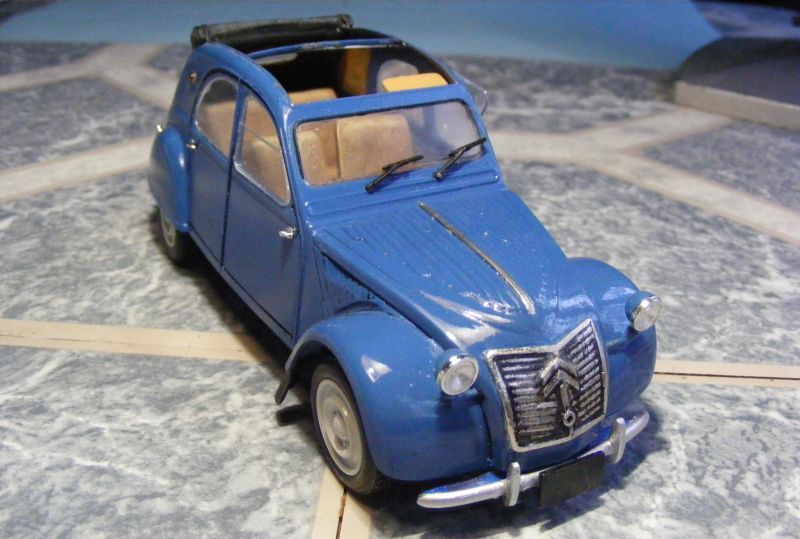
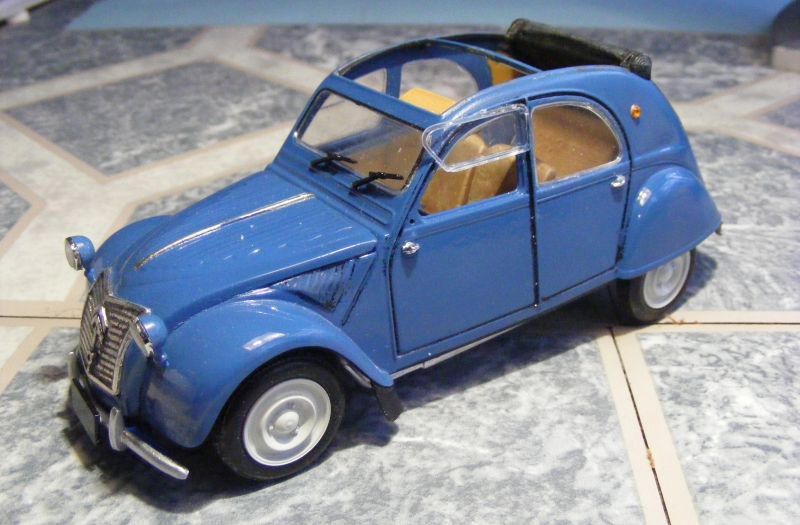
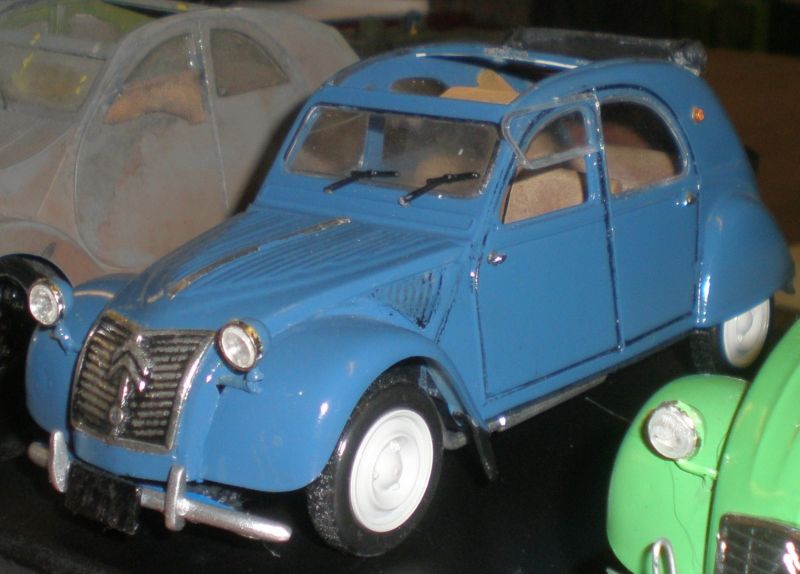
Built by Rod, straight from the box in January 2006, from the 1996 Heller release, this is a straightforward kit with a suitable level of detail. The important part here being the ripple bonnet which Rod could use as a scale template for the 1/24th scale version he wanted to make. 25 years ago this 1/43rd kit was the only plastic kit of the early 2cv. The build date is worth noting as Rod built by far the majority of this 1/43rd scale Heller range back in the early 1980s as they were released.
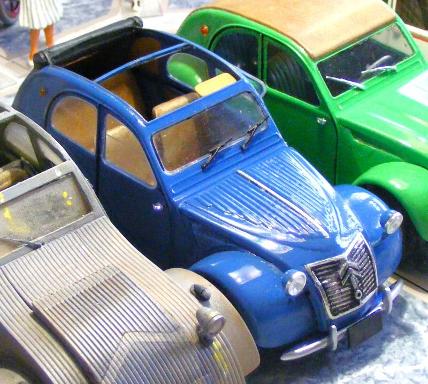
The 1/24th scale ripple bonnet 2cv was converted by Rod from the Heller 1/24th scale kit, # 80765. That kit was first released in 1991, followed by the Airfix 06417 release in 1992 as the Citroen Dolly (which has also built). In true Heller fashion the kit has been re-released a further 10 times through to the 2020s. It has clearly been a popular kit, but this is largely due to its fair price compared to the far superior (but much rarer), Tamiya kit released in 1995. Detail is acceptable for the price
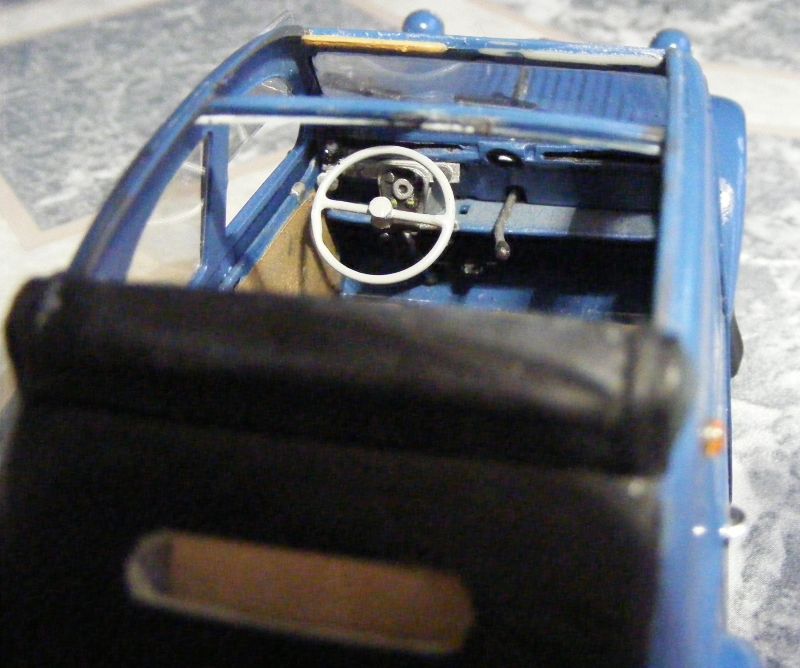
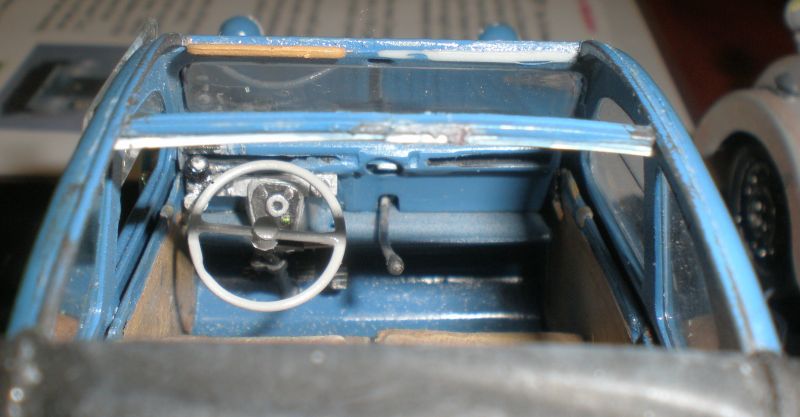
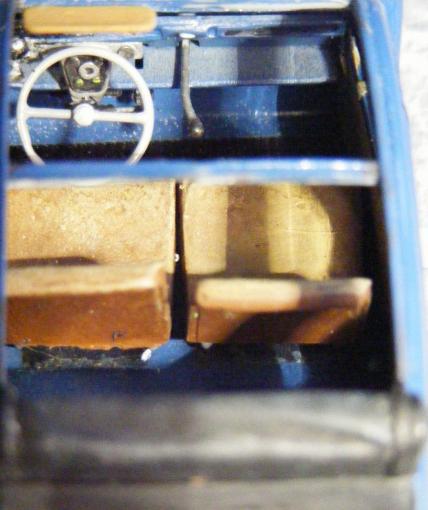
This kit conversion was undertaken by Rod during February/March 2011, taking the later 2cv model and back dating it to a 1955 ripple bonnet car. Obviously, most of the work was done on the bonnet to re-profile it and add the ripples and different front grill. After cutting back the plastic roof Rod built the roll top and reduced the rear window size to the period specification, all of which necessitated the interior being back-dated too. A new dash and instrumentation was made and the seats needed simplifying too. Other external changes were the addition of the indicator lights on the 'C' pillars dating it as a 1955 version.