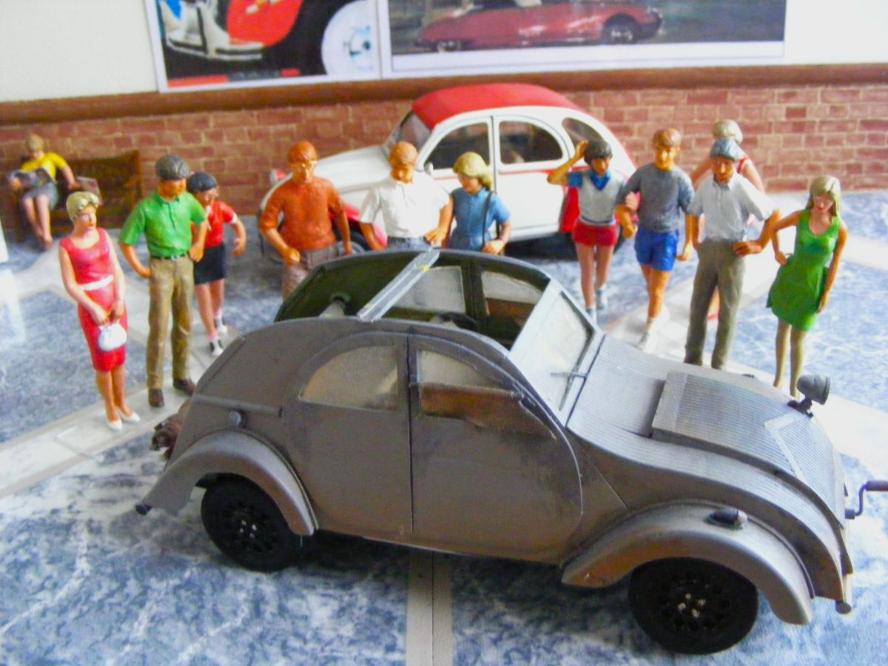
1937 Citroën TPV, Prototype 2CV.
According to legend Pierre-Jules Boulanger, Vice-President and Chief of Engineering and Design at Citroën, became stuck behind a farm cart out in the French countryside. Instead of becoming frustrated he pondered on the problem, why are French farmers having to travel at the walking pace of a horse? “Why not offer French farmers a better mode of transport?” If Citroen gave them a well-designed motor vehicle speed would not be the only benefit. Horses need a lot of time and care, cost money in feed and veterinary bills, all of which would be reduced or eliminated if a cheap reliable motor car was available.
Back in his office Boulanger started putting his thoughts on paper; not with design sketches but as a list of what he the French farmers needed. This led him to the immortal specifications of the 2CV.
“The car had to be able to transport up to four passengers, it needed to be able to cross a freshly ploughed field with a basket of eggs on the back seat without any of the eggs getting broken, that the car should be able to comfortably be driven on the worst of French potholed muddy roads, and that it should have the load carrying capacity to take a 50kg sack of produce or a full cask of wine to market.”
Fuel consumption was to be 3Ltrs per 100kilometers, or 95miles per British Imperial gallon, the car must be robust, able to run fifty-thousand kilometres without the replacement of any mechanical parts so that service and maintenance costs were minimal, no more than ten francs.
During the 1930s Pierre-Jules Boulanger oversaw a revival of Andre Citroen’s “culture of technological excellence” establishing a new automobile research department that would be unrivalled in Europe for more than three decades. His particular belief was that “engineers trained at the universities and Grand Ecoles were blinkered by their formal education and incapable of truly original thought”, so, he only employed men who had gained their qualifications though evening classes. Boulanger’s reasoning being these men would not settle for imitation or dogma and would be innovative with their new ideas.
The Traction Avant was a triumph of avant-garde design and manufacturing engineering; the TPV was to be just as ground breaking. In the case of the TPV this would be because of its simplicity rather than any new feature.
At a time when most of Europe was searching for a small car design, like Dr. Porsche and his VW Beetle, Fiat and their Topolino in Italy; Citroën’s egalitarian concept took the ideology to the extremes of frugality and arguably became the most enduring and versatile of all the ‘Peoples car’ designs.
It was 1936 when Pierre-Jules Boulanger passed his ideas to chief engineer André Lefebvre and a design team that included Italian stylist Flaminio Bertoni, Italian engine designer Walter Becchia and suspension specialist Alphonse Forceau Boulanger stipulated they work in absolute secrecy at the Michelin facilities at Clermont-Ferrand and at Citroën in Paris, referring to the quite unique car as the TPV, short for “Très Petite Voiture” or “Toute Petite Voiture”; “very small car” or “Tiny car” in English. Wanting a hero for rural France, Boulanger gave his design team one last instruction, ... “Don't worry about how it looks.”
Boulanger had every intention of being closely involved with the projects progress. He even set up a department with the single role of checking the weight of each part then to redesign it to make it lighter. The most important part of all the design process though, was secrecy. It was vital that Citroen’s French rivals Renault or Peugeot didn’t catch on and start their own ‘tiny car’ project.
Importantly this new vehicle was not just a Citroen project. In 1934 Citroën was bankrupt and taken over by Michelin tire company making Pierre Michelin president of Citroën. Michelin worked on a revolutionary new radial tire specifically for the TPV, so tires and suspension were created together to compliment each. By the time Pierre Michelin was killed in a car crash on the 29th of December,1937 and Pierre-Jules Boulanger became Citroën’s President, 47 technically different prototypes, with incremental improvements, had been developed and the TPV concept was finalized.
In the middle of 1939 250 pre-production cars were built and ready to be presented to the press and public when the Paris Motor Show was to be held in October 1939. All the necessary brochures, posters and flyers were prepared, proudly announcing the arrival of the Citroën 2CV; but Adolf Hitler put an end to the debut.
World War Two not only put an end to the launch, it very nearly erased the TPV from history.
After the “Drôle de guerre” (Joke of a war), or “Phoney War” as the British called it, ended in 1940 France began to fight for her life. By July 1940 the Germans occupied much of northern France, Paris included, and Pierre-Jules Boulanger needed to hide his new vehicle from exploitation by the Nazis. He gave orders that all the TPV prototypes and pre-production 2CV cars be dismantled destroyed. Most were, some were buried, one was disguised as a pickup and a small lucky few were hidden.
However, the Nazis were able to requisition the plans and production machinery which they packaged up and put on railway wagons for transportation to the ‘Fatherland’. Fortunately, the French Resistance were able to re-label the wagons as “agricultural equipment” and they were dispatched all over Europe to be hidden; some so well that Boulanger feared he wouldn’t be able to retrieve them again when the war was over. What little information did make its way to Germany ended up in Wolfsburg where the great Dr. Ferdinand Porsche, wholly unimpressed, called it a ‘soapbox jalopy’!
Throughout the second world war the French automotive industry was pressed into the service of the Reich, largely producing trucks. But Pierre-Jules Boulanger personally refused to collaborate with the Germans and would not even speak with Ferdinand Porsche, the head of the German Automotive overseers. Boulanger did everything he could to slow down production of war equipment for the Nazis and had engine oil dipsticks remarked so that engines would seize unexpectedly due to insufficient oil. For his acts of resistance Pierre-Jules Boulanger was labelled an “Enemy of the Reich” by the Nazis and remained on the Wehrmacht’s most wanted list until the end of the war.
It was believed all the TPV prototypes were lost after the war as they were so well hidden. However, according to an internal memo Citroen ordered they be scrapped. But, workers who appreciated the historical value of the TPVs, hid some from management although two prototypes soon re-emerged, and that was that for decades.
In 1995 three different prototypes were unexpectedly discovered hidden by hay bales in a barn at the Bureau d’Etudes at Ferté-Vidame. They have been kept ‘exactly’ as they were found and the legend of Citroën’s 1939 cyclopes was cemented in automotive history.

TPV design
One of the key factors in reducing fuel consumption. At the lime Citroen believed aluminium was not only lighter and more durable it was going to be cheaper to purchase than steel. The TPV design was to incorporate magnesium for its light weight and strength too, not recognising that it burnt very well!
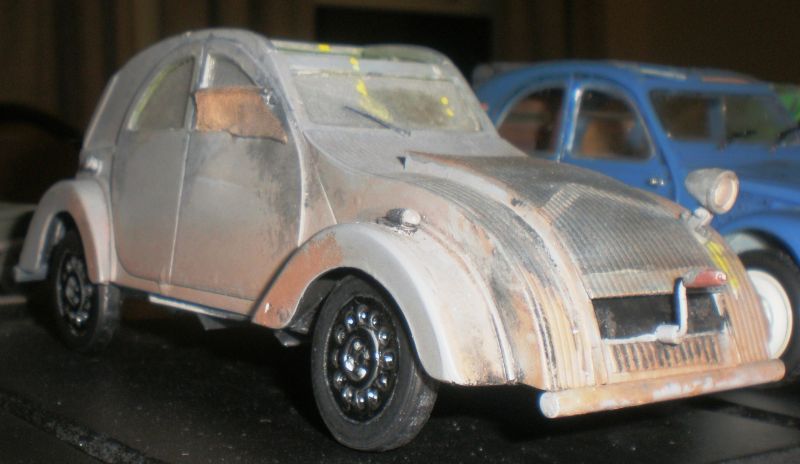
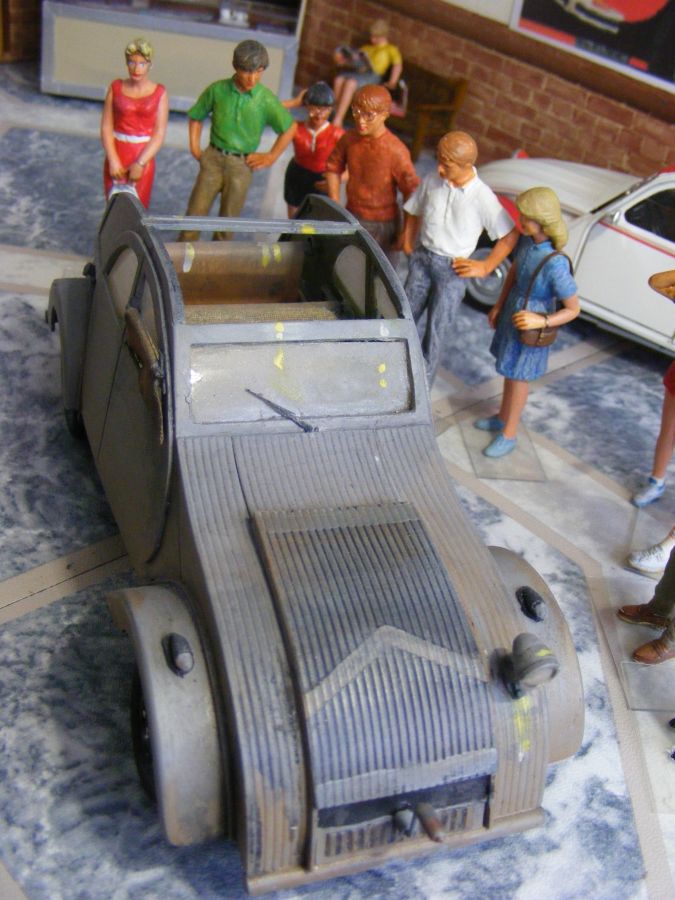
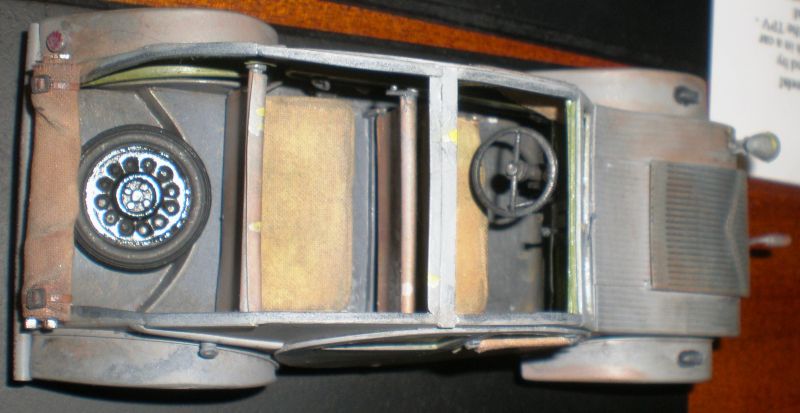
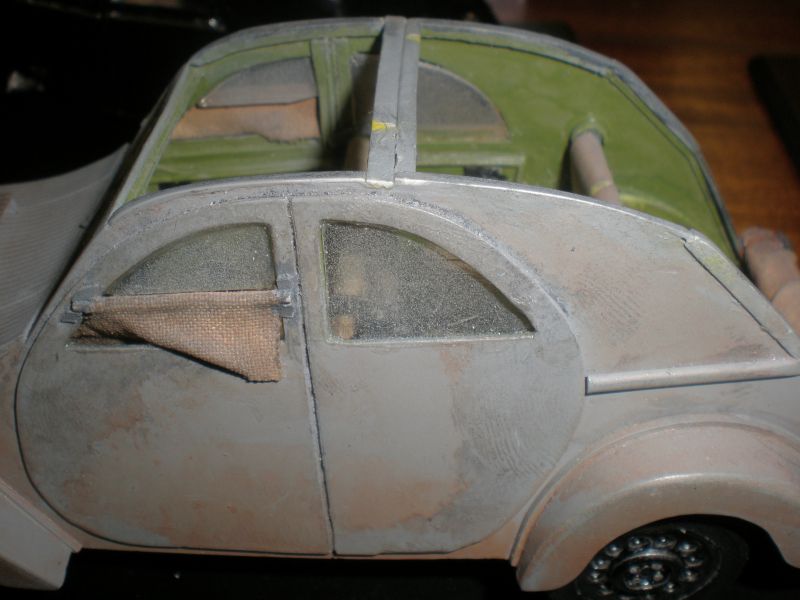
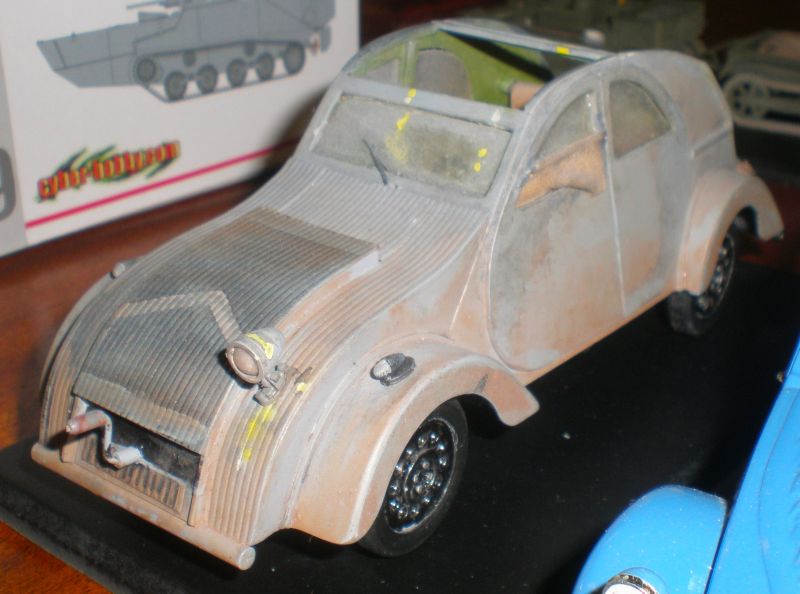
The body was made from rudimentary corrugated aluminium and some flat panels. Another weight saving idea was the full-width, canvas, roll-back roof that ran almost to rear bumper. Canvas is lighter than metal and the feature also allowed for transporting oversized loads. This particular solution also gave birth to the "umbrella on wheels" name.
Flaminio Bertoni’s early design was a very basic utilitarian silhouette. This design would be revised regularly, particularly when it became clear Aluminium wasn’t going to be cheap enough to go into production with. The body became largely flat steel panels, the roof line was also raised as Boulanger thought it right that the driver should be comfortable while wearing his hat while driving.
French law only required one headlight and one taillight and initially the single headlamp was set in the centre of the bonnet. This proved to be dangerous in practice and the lamp was moved to the left, the French driving on the right. Eventually two head lamps became the preferred solution, mounted on the wings. Also in the name of good visibility, the prototypes had a single wind-screen wiper operated by hand on the driver’s side.
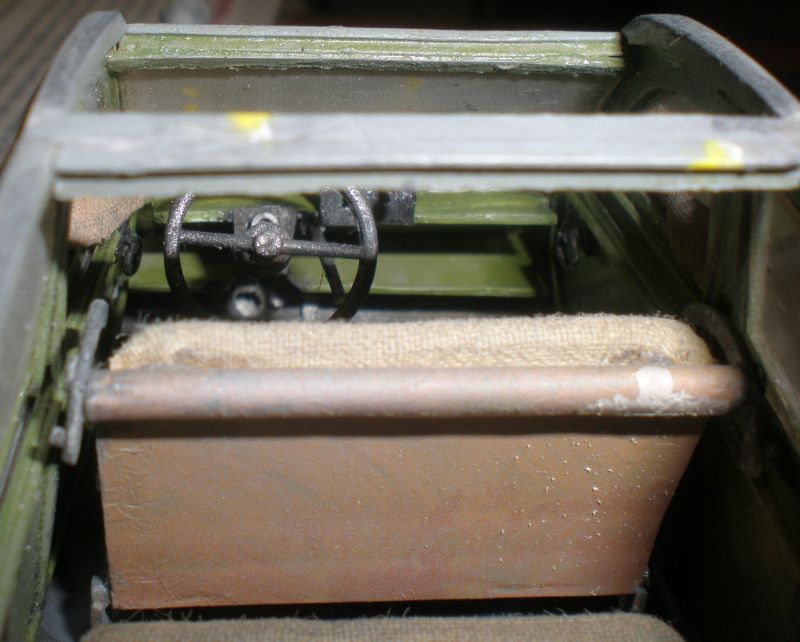
The interior was very spartan indeed. Early seating ideas included hammock style seats suspended from the roof line and cross-bars. Although they worked to a degree, they proved largely unsatisfactory when driving and were abandoned for a more conventional tubular steel frame design with springing by rubber bands.
The early engine thoughts saw a 500cc motor-bike engine Walter Becchia expanded on the concept to design a water-cooled two-cylinder unit incorporating some aluminium and magnesium parts. The engine design evolved through a 180-degree, V twin air cooled to become a 700cc horizontally opposed 2-cylinder engine, still using light weight metals were possible. As the car had a low weight of just 370kg this engine size was enough to take the car to a speed of 37mph.
The prototypes started with a three-speed gearbox to send power to the front wheels. This became a subject of much discussion with Becchia persuading Boulanger a four-speed gearbox would be better. Becchia was able to design a four-speed ‘box in the same space as the three-speed unit at little extra cost. Although extra gears meant extra weight, Becchia argued that four-speeds would be better pulling the car which was heavier anyway due to the switch to steel panels.
Development of the ladder frame chassis was straight forward. Early test drives show the drivers running on bare chassis’ with only rudimentary seating and controls. Most development time was pent on the suspension. Lefèbvre had designed the Voisin GP car in the early 1920s and his particularly interested was maintaining maximum tyre contact on the road surface. Alphonse Forceau came up with a suspension system consisting of a leading arm front and a trailing arm rear suspended by eight torsion bars including an intermediate, and an overload bar for each side. This complicated system would come into play incrementally as loads increased. Although it was very good by 1944 Citroën had conducted their first studies with hydro-pneumatic suspension so the torsion bar suspension never made it to the actual 2CV production cars.
As noted above, André Lefebvre and Flaminio Bertoni continuously improved the designs in secret through World War Two. Their belief in the project never wavered and would eventually come to fruition in 1948. The Citroën 2VC would prove to be the most functional and long-lasting design of all the ‘new’ European cars launched in the immediate post war period.
The model
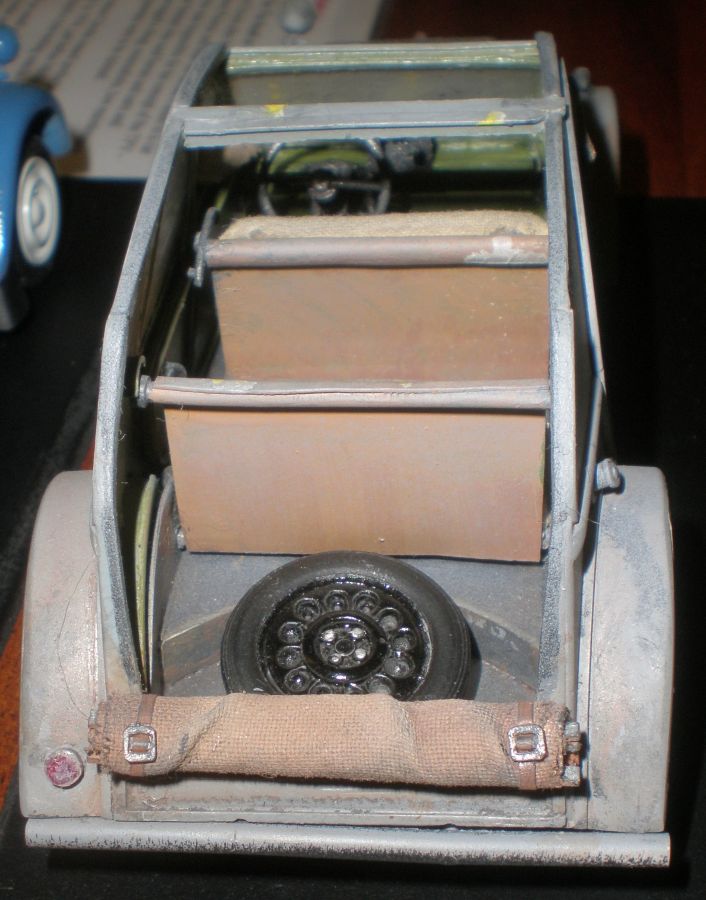
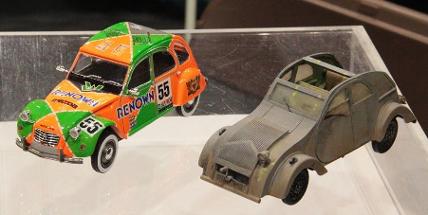
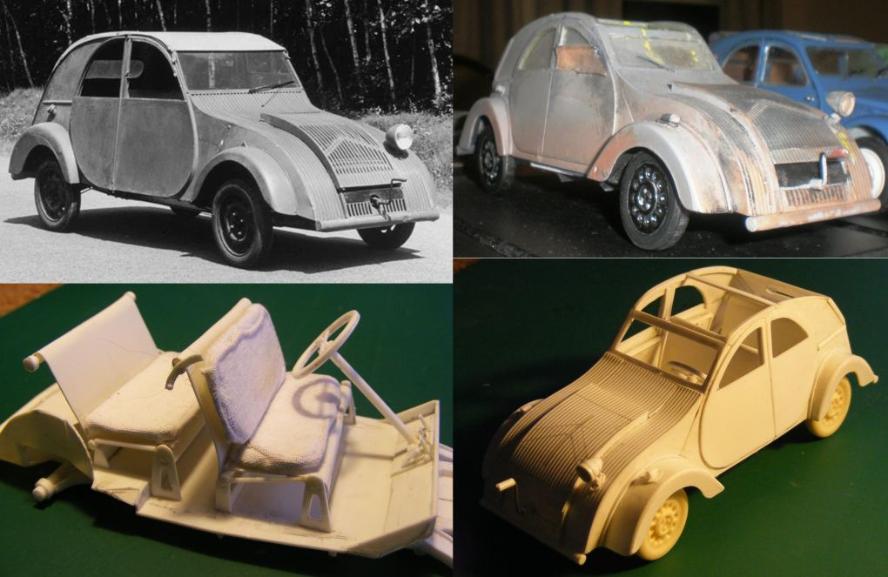
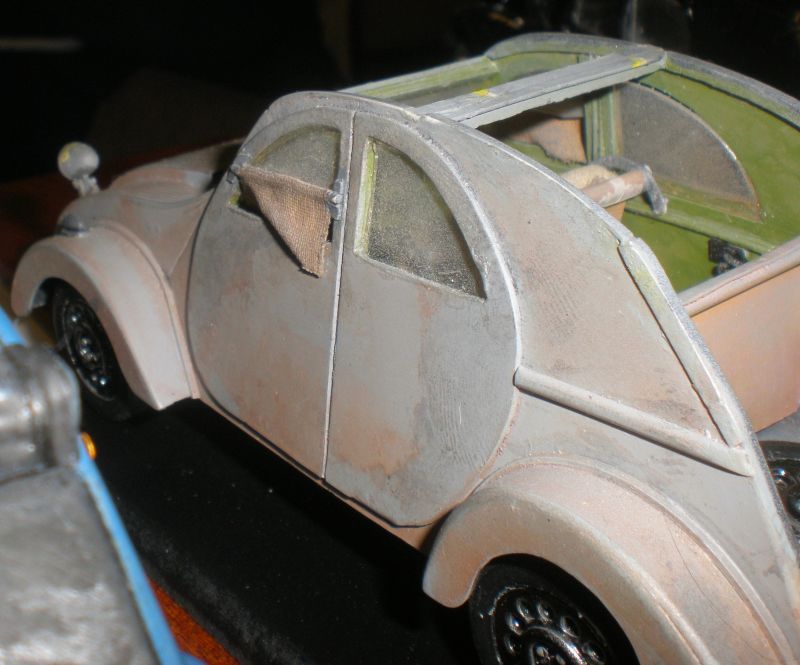
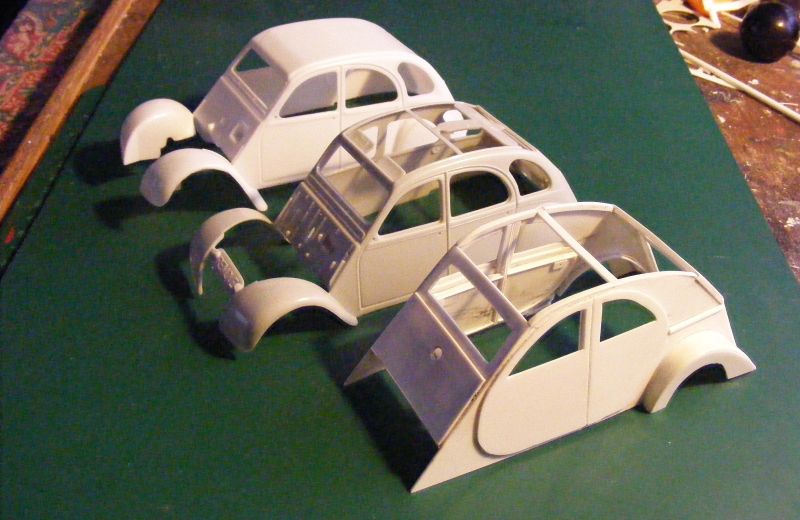
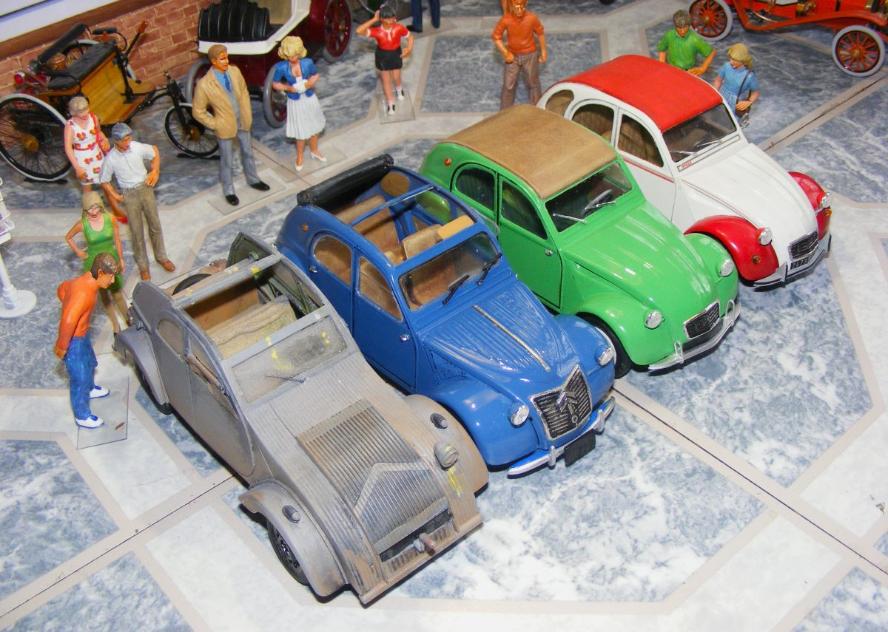
The model was built from scratch by Rod, using only plastic card, strip and rod. Parts like the wheels where a multiple number were required had a master made and then a mould taken so the requisite number could be cast in resin at home.
Rod even drew his own plans to build the model and sketched the details for positioning parts too. Fortunately the car was popular on the internet and lots of detail photos could be found. With the assistance of instruction sheets for the other 2CV kits Rod was also building it didn't take Rod long to solve all the various problems that scratch building inevitably brings.
As for the painting, priming was done with Halfords acrylic car spray paint cans. The additional painting for colours and weathering were by Art-Deco acrylics backed up by Revell and enamel hobby paints; all applied by brush.
RETURN TO:-